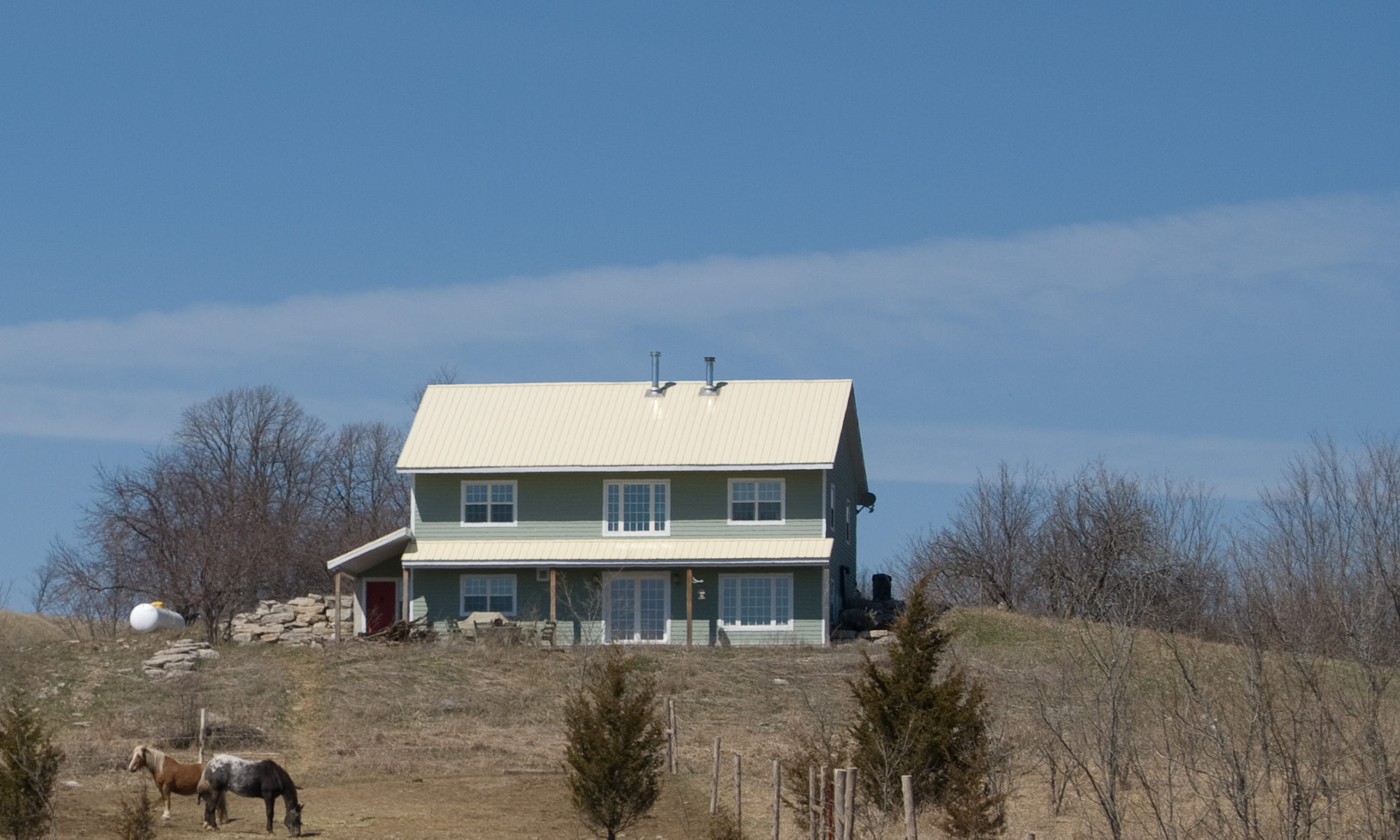
A rubble trench foundation is a way to build the foundation that more environmentally friendly than the typical concrete footings. It uses much less concrete than a typical concrete stem wall and also can use local materials. It also provides both a structural foundation and drainage in the same system. One limitation is that it can only be used with a slab on grade or with a stem wall and crawl space. The basic process is to dig a trench to below the frost line and then line the bottom with gravel. A perforated drainage pipe is laid on top of the gravel and then the trench is filled with stone or concrete rubble to grade. A steel reinforced concrete grade beam is then poured directly on top of the rubble. The rubble trench foundation produces a resource efficient, high quality, low cost foundation.
The rubble trench foundation have been used for thousands of years by was popularized early in the 20th century by Frank Lloyd Wright, who used it in a number of his buildings. Today rubble trench foundations are commonly used in straw bale buildings due to their low environmental impact. A major advantage of the rubble trench foundation is that it is not susceptible to frost heaving. Since the foundation is made of materials that rapidly drain, there is no water to freeze, and so no frost heaving. The disadvantage of a rubble trench foundation is that it needs to be in well drained soil where the water table is below the bottom of the rubble trench. It also works best on a sloped site where the drainage from the bottom of the trench can go to open air. If the water table is low enough and the soil well enough drained, drainage can be accomplished on a flat site with a dry-well. A dry-well is a hole that is below the drainage point that is filled with loose gravel or rubble and will accept the drain-water and slowly disperse it into the ground. The dry-well has to be above the water table in order to work properly.
When building using a rubble trench foundation, you will probably need to get an engineer’s drawing made for it, as it is not included in the building code in most places. The soil may have to be tested to see if it support the rubble trench and the building above it. The basic procedure to create the rubble trench foundation is to first dig the trench, usually about 16 inches wide, with straight sides to a few inches below the frost line (4 feet in Southern Ontario). This is most easily done with a backhoe, but can be done by hand. The trench must be dug so that there is a slope of at least 1/8 inch per foot of slope for drainage. Once the trench has been dug, place landscape fabric on the bottom of the trench and cover it with a few inches of gravel. Then place a 4 inch perforated pipe on the gravel and have it follow the drainage slope either to open air or to a dry-well. The sides of the trench should then be lined with the landscape fabric in order to stop silt from migrating into the rubble and plugging up the drainage. After the landscape fabric has been laid the trench should be filled with washed 1 1/2″ stone or crushed concrete about a foot at a time and then tamped to reduce settling. After the trench has been filled to grade, forms must be laid in a layout according to the engineered drawings and the re-bar installed. The concrete grade beam can then be poured. Once the concrete has cured, the forms can be removed and the building can begin.
Looking to live off grid in eastern ontario lots of information I have seen before and a few new things as well. I am very interested the names of any current books to read on passive solar, and green design.
I have a list of books on the site for my ownerbuilt home at http://www.ownerbuilder.ca/amazon.php
I am considering using a rubble trench foundation on PEI. Locals query whether the very unstable sandy soil here will cause the foundation to shift. Also, the foundation will be on a flat grade about 20ft. above sea level. IE, high water table is suspected. After reading the article on this site, comparing it to the 14″ trench used under the Rowe’s 2-storey straw bale house near Cochrane, Alberta, I wonder why a 4′ trench (min. frost level here) is recommended. Can anyone answer these ponderments? Thanks.
Hi Sunny, I just completed my rubble trench in eastern PEI and I’m hoping it will do what it’s supposed to. I won’t know for some time whether or not it will be stable enough to keep my house firmly planted where I build it but in a few years I’m sure I’ll be able to tell you! As far as your question goes about digging down to below frost, the information that I’ve gathered informs me that if you don’t dig your trench below frost, the ground below your trench would still be susceptible to frost heave because it will potentially be saturated with water during a freeze/thaw cycle. The trench, in this scenario could be pointless because the heaving ground below it could push up on it and move your building. An alternative to the rubble trench foundation is the shallow trench foundation (a foundation that allows for a more shallow foundation by utilizing horizontal insulation around the perimeter of the building). I’m definitely not an expert but I hope this helps!
Perhaps this bit from CMHC could be of some help?
http://www.cmhc-schl.gc.ca/publications/en/rh-pr/tech/2000-127E.html
Interesting article. Thanks for the link
Hi Sunny: Did you ever build your house back there yet?
Out here on the we(s)t coast, the city of Richmond is built on nothing but river sand, deposited over the last few thousand years. In most parts of Richmond, which is generally as flat as a pancake, the water table is only inches below the surface. So I wouldn’t be too worried just because you are on sand.
We did a few three storey residential apartment buildings, and the footings were done thusly. Any topsoil that is there is removed. And there is very little of that.
Where the concrete footing – usually 24″ wide x 8″ deep – is to be poured, the area is pounded with a jumping jack until it is extremely hard. The inspector carries a piece of re-bar with him and tries to drive it into the ground as a test. Once it is firm enough, the footings are poured completely above ground level…in other words there is no excavating done at all. It is often necessary to add sand in the event that topsoil has been removed, to bring the ground up high enough. There are NO basements and NO inground swimming pools in Richmond. The static water pressure from the high water table would lift them out of the ground – or so they claim.
I am at this time hoping to buy a beautiful piece of land in the Millvale area of PEI and want to build my own cabin. I am a 50+ year old woman and am determined to do it myself as much as I can . I have skills and the tools. Am looking at the easiest way to do a foundation for a small house 20 x 20 built into the bank. Half the house on the lower level would be in the bank facing north for my art studio and the top level would be above ground facing south with solar stuff going on. Any advice on the foundation? I am willing to do a lot of work but as a woman I havlimited strength.
Since it is into the bank with a walkout, that limits your choices. The easiest(and strongest) would be to hire it out and get a poured concrete foundation (which is what I did on mine). The other options would be cement block, insulated concrete forms (ICF) or stone, but you would have to check with the building inspector to see if stone would be allowed. Remember that you will still have to build the foundation down below the frost line at the walkout. It might be worth talking to an engineer or the building inspector to see what has worked best in your environment and soil types.